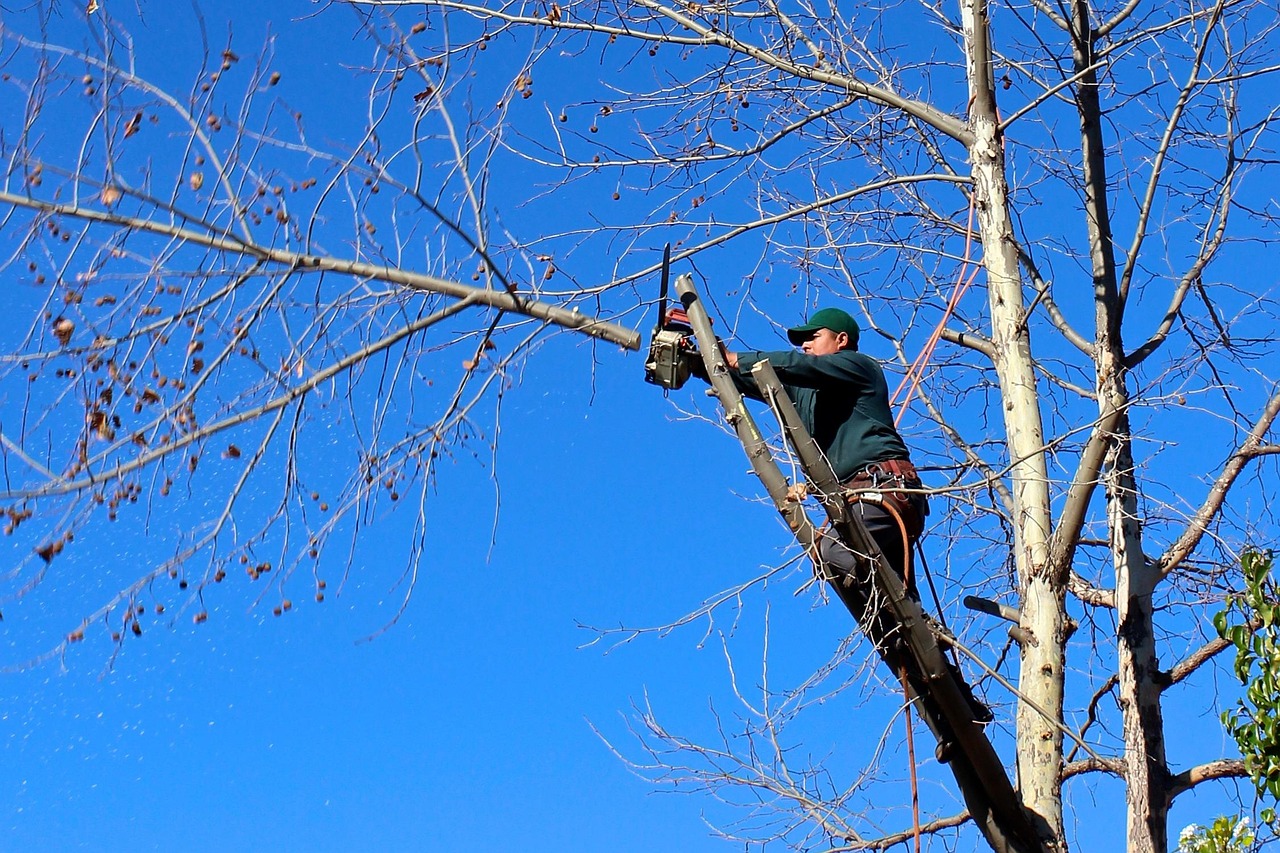
Tree service in Norwalk, CA covers the trimming, removal and stump grinding that keep residential trees safe and healthy across the city, from the older blocks near Firestone Boulevard to the neighborhoods off Imperial Highway. Our work is for Norwalk homeowners who want their trees under control without guessing what is safe to cut. We prune overgrown canopies, take down trees that have become a hazard and grind out the stumps they leave behind. The result is a yard with sound trees, clear rooflines and nothing left in the way.
What Tree Work Do We Handle in Norwalk?
Most calls in Norwalk come down to three kinds of work. Follow the links for a closer look at each.
- Tree trimming: thinning, raising and shaping canopies, clearing branches off roofs and away from service drops, and removing dead wood.
- Tree removal: taking down dead, dying, leaning or storm-damaged trees, including trees in tight backyards that have to come down in sections.
- Stump grinding: grinding stumps below the soil line so the spot can be replanted, paved over or turned back into lawn.
We also take on tree pruning, land clearing, emergency tree services, cabling and bracing, and disease control. These often come up during a larger job, for example when a removal reveals that a neighboring tree has a weak limb that also needs work.
How Norwalk’s Neighborhoods Shape the Work
Much of Norwalk was built out in the postwar years, so many homes sit on modest, fenced lots with a single-car driveway, a block wall at the back and a garage near the property line. Trees planted decades ago have now outgrown that space. A Chinese elm or a ficus that once shaded a patio can end up lifting the slab, filling the gutters and pushing against the wall.
That layout affects how tree work is done. There is rarely room to drop a large tree in one piece. Crews often carry gear through a side yard, set up on a narrow driveway and lower each piece by rope. Planning the job around gates, wall heights and where the chipper can park matters as much as the cutting itself.
Parkway trees belong to the City
The trees in the strip between your sidewalk and the street are City of Norwalk trees. The City’s tree program looks after more than 16,000 of them and prunes residential street trees on a regular cycle. Species on the City’s planting list include Chinese pistache, crape myrtle, southern magnolia, camphor and Canary Island pine. If a parkway tree is damaged or sick, the right step is a work order with the City. Our work covers the trees on your side of the property line.
How Does the Local Climate Affect Norwalk Trees?
Norwalk has the long, dry summers and mild winters typical of southeast Los Angeles County. Most rain falls between late fall and early spring, and many trees go months without a drop. That pattern creates a few predictable problems:
- Drought stress weakens trees that depend on irrigation. When a lawn sprinkler is turned down or removed, the trees around it often suffer next.
- Wind events in fall and winter test heavy, untrimmed canopies. Dense crowns act like sails, and weak limbs are the first to fail.
- Shallow roots are common in trees watered only by lawn sprinklers, which makes them more likely to lift sidewalks and tip in saturated soil after a rare heavy storm.
Regular thinning, deep watering and early attention to cracked or dead limbs go a long way toward preventing damage.
Power lines and service drops
Many Norwalk streets have overhead lines, and the line that runs from the pole to your house, called the service drop, often passes through or near a backyard tree. Southern California Edison serves Norwalk, and branches touching energized lines should be reported to the utility. Once the utility has made the line safe, a tree crew can prune the rest of the canopy so it grows away from the wire.
How Does a Tree Service Job Work?
Every job follows the same basic steps, whether it is one fruit tree or a full backyard.
- Get in touch by phone or the form, sharing the street, the tree’s trouble and a photo if handy.
- A free on-site quote. Someone looks at the tree, the access and anything nearby that needs protecting, then explains the options.
- A written quote that lists the work, the cleanup and anything that is not included, such as stump grinding.
- The work day. The crew protects the area, makes the cuts in a safe order and lowers anything heavy by rope where needed.
- Cleanup. Branches are chipped, wood is hauled and the yard is raked and blown before the crew leaves.
How Should You Choose a Tree Service in Norwalk?
Trees are heavy, and mistakes can damage a house or injure someone. A few questions help you compare tree services before you agree to any work:
- Will they explain the cuts? A good crew can tell you which limbs come off and why, and what the tree will look like afterward.
- Do they avoid topping? Cutting a tree’s main stems back to stubs causes weak regrowth. Proper pruning removes branches back to a healthy junction.
- Is the quote written and specific? It should say what is included, especially cleanup, haul-away and stump work.
- How will they protect your property? Ask how they plan to handle tight spaces, walls, roofs and lawns.
- Can they show insurance paperwork? Asking any tree service for proof of coverage before work starts is a reasonable request.
Areas We Serve Around Norwalk
We work throughout Norwalk and in the nearby communities of Downey, Bellflower, Cerritos, Artesia, Santa Fe Springs, La Mirada and Whittier. If you are close to Norwalk and not sure whether we cover your street, call and ask.